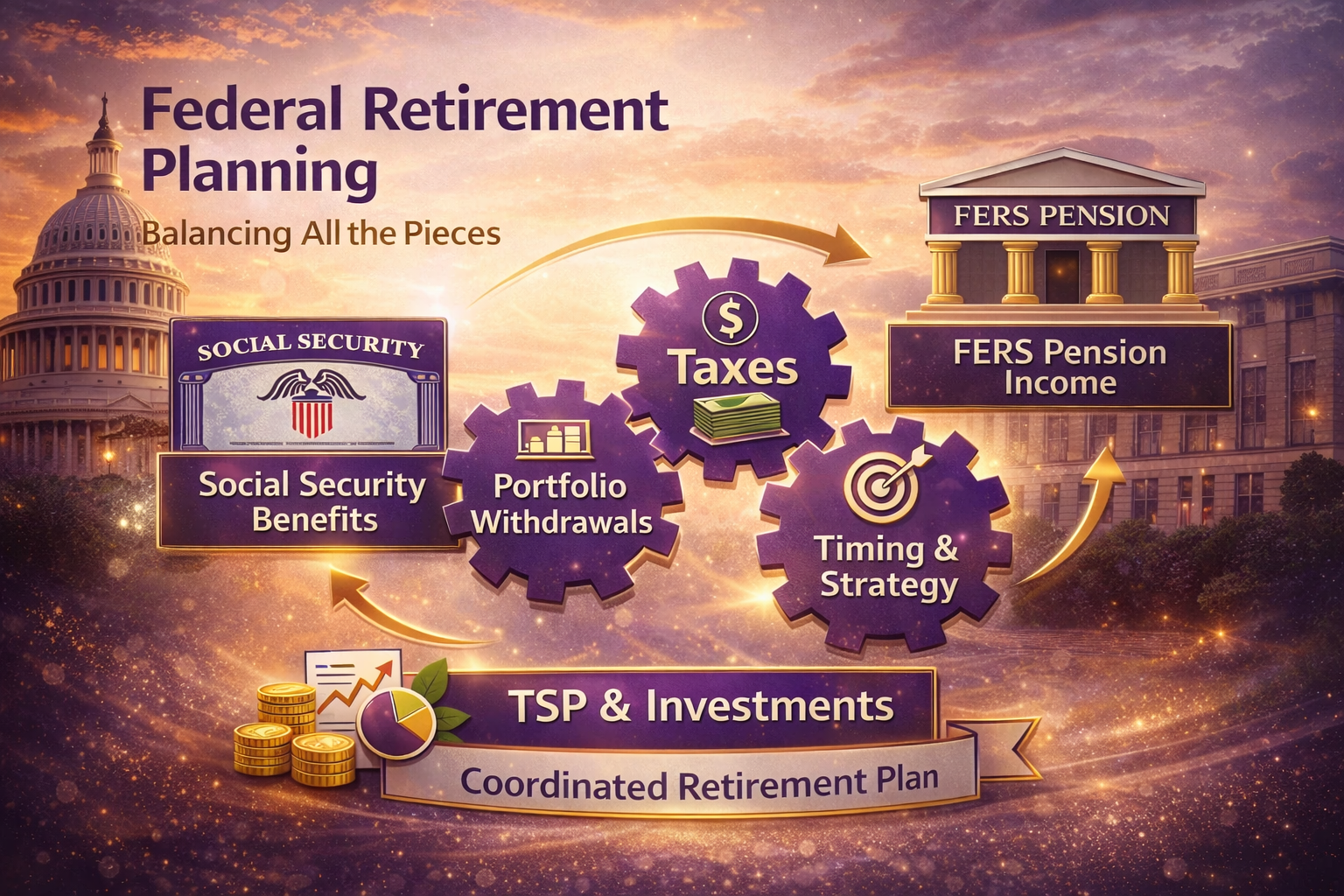
If you’re a federal employee in your mid-40s to mid-60s, you’ve likely spent decades contributing to the Federal Employees Retirement System (FERS). You already have a solid foundation: a defined pension, Social Security, and the Thrift Savings Plan (TSP). Yet many federal employees reach their late career years wondering if it will be enough. They assume years of service alone will carry them through. In reality, the difference between a comfortable retirement and one filled with uncertainty often comes down to small, strategic decisions made in the final decade of your career, specifically decisions around timing, salary, and how you coordinate your benefits.
Retirement for federal employees isn’t simply about reaching a savings number. It’s about creating reliable, sustainable income that lasts through decades of retirement, keeps pace with inflation, and supports the lifestyle you’ve earned. Many people retire unprepared, not broke but without a clear structure for turning their benefits into steady cash flow. The good news is that even if you feel behind, there is still time to make adjustments that can meaningfully strengthen your outcome.
Understanding Your Retirement Timeline
Your eligibility for full, unreduced FERS pension benefits depends on two factors: your age and your years of creditable service. According to the U.S. Office of Personnel Management (OPM), you qualify for an immediate, unreduced annuity if you meet one of these combinations:
- Minimum Retirement Age (MRA) with at least 30 years of service
- Age 60 with at least 20 years of service
- Age 62 with at least 5 years of service
Your MRA is determined by your year of birth and typically falls between 55 and 57. Retiring exactly when you become eligible for unreduced benefits helps protect your pension from permanent reductions.
Retiring earlier can trigger reductions. For example, if you leave under the MRA+10 provision (MRA with only 10 years of service), your annuity is reduced by about 5% for each year you are under age 62. Choosing to work a few extra years until you hit one of the full-eligibility thresholds can eliminate that reduction entirely and increase your high-3 average salary at the same time. A difference of just three years can add thousands of dollars to your annual pension for the rest of your life.
The key takeaway: your timeline is flexible. Small delays in retirement, when feasible, often deliver outsized benefits because they combine more service credit, a potentially higher salary, and protection from reductions.
How Your FERS Pension Is Calculated
Your FERS pension is straightforward once you understand the components. The formula is:
High-3 average salary × years of service × multiplier (1% or 1.1%)
- High-3 average salary is the average of your highest three consecutive years of basic pay (usually your final years).
- Years of service include all creditable civilian federal time, plus any military time for which you’ve made a deposit. Unused sick leave can also be added to your service credit for computation purposes.
- Multiplier is normally 1%. However, if you separate from service at age 62 or older and have at least 20 years of service, the multiplier increases to 1.1%. This 0.1% boost is permanent and applies to every year of service.
Here are two illustrative examples (based on hypothetical figures; actual results depend on your individual pay history, service, and eligibility):
Scenario 1: You retire at age 62 with 30 years of service and a high-3 average salary of $100,000. Because you meet the age and service requirements, the 1.1% multiplier applies. Annual pension ≈ $100,000 × 30 × 0.011 = $33,000.
Scenario 2: You continue working a few more years, reaching age 62 with 32 years of service and a high-3 average salary of $115,000. Annual pension ≈ $115,000 × 32 × 0.011 = $40,480.
Scenario 1: You retire at age 62 with 30 years of service and a high-3 average salary of $100,000. Because you meet the age and service requirements, the 1.1% multiplier applies. Annual pension ≈ $100,000 × 30 × 0.011 = $33,000.
Scenario 2: You continue working a few more years, reaching age 62 with 32 years of service and a high-3 average salary of $115,000. Annual pension ≈ $115,000 × 32 × 0.011 = $40,480.
The annual difference is $7,480. Over 20 years of retirement, that adds up to roughly $149,600 in additional income (before any cost-of-living adjustments). These figures are for illustration only and do not account for taxes, COLAs, or other income sources. They do show how modest changes in timing and salary can create meaningful long-term impact.
The TSP: One Important Tool in a Larger Strategy
The Thrift Savings Plan offers low-cost investing and the benefit of agency contributions, but it is not a standalone solution. It works best as part of a coordinated income plan.
Under FERS, your agency automatically contributes 1% of your basic pay to your TSP every pay period. If you contribute 5% of your own pay, the agency will match an additional 4% (100% match on the first 3%, 50% on the next 2%). That brings the total agency contribution to 5% when you contribute 5%—essentially free money that can compound over time.
Consider a $90,000 salary example: Contributing 5% ($4,500 per year) triggers roughly $4,500 in combined agency automatic and matching contributions. Over 20 years of consistent participation (before any investment growth), that’s $180,000 in combined employee and agency money. With reasonable long-term growth, the account balance can be substantially higher. Yet the real value emerges when you shift from accumulation to withdrawal strategy, deciding how much to draw each year, how to coordinate with your pension and Social Security, and how to manage sequence-of-returns risk.
The TSP is powerful, but its success depends on the broader plan around it. Strategy matters more than the account balance alone.
Why Growth Matters—And Why “Playing It Safe” Can Be Risky
Many pre-retirees focus on protecting what they have. While capital preservation feels prudent, it can quietly erode purchasing power over a retirement that may last 25 or 30 years.
Consider a simplified illustration: Suppose you have $200,000 in your TSP or other savings. If the balance earns no meaningful growth (for example, sitting in low-yield options), it stays close to $200,000 after 20 years, before inflation.
If instead the same $200,000 grows at an average annual rate of 5% (a conservative long-term assumption after fees), it grows to approximately $530,000 after 20 years. That growth helps offset inflation and provides a larger base from which to generate sustainable income.
Inflation and longevity are the two forces that most often surprise retirees. A thoughtful mix of growth-oriented investments, balanced with stability, can help your savings last. The goal is not to chase high returns but to give your money a reasonable chance to keep up with rising costs.
Retirement Is About Income, Sustainability, and Structure
The most common regret we see is not insufficient savings but the lack of a clear withdrawal and coordination plan. Federal employees often have three strong pillars: FERS pension, Social Security, and TSP/other savings. The challenge is turning those pillars into predictable monthly income that rises with inflation, survives market volatility, and accounts for healthcare, taxes, and longevity.
A solid strategy considers:
- When to claim Social Security to maximize lifetime benefits
- How to sequence withdrawals from taxable, tax-deferred, and tax-free accounts
- How to manage healthcare costs before Medicare eligibility
- The role of part-time work or delayed retirement in bridging gaps
These decisions matter more than any single “magic number.”
Moving Forward with Clarity
Even if you feel you started late or experienced setbacks, federal employees under FERS have structural advantages that many private-sector workers do not. You don’t need a perfect plan, you need a clear one. By understanding your eligibility windows, optimizing your high-3 salary, capturing every available TSP contribution, and planning for sustainable growth, you can retire with greater confidence.
Retirement planning for federal employees is ultimately about informed decisions, not perfection. Take time to review your personal numbers, consider how small adjustments today could compound over decades, and build a strategy that turns your benefits into reliable income for the years ahead.
We’re committed to providing straightforward, non-salesy education for federal employees navigating this transition. If you’d like more practical guidance on FERS coordination, pension timing, or income planning, stay connected for future articles and resources. The decisions you make in the next few years can shape your retirement for decades, clarity now makes all the difference.