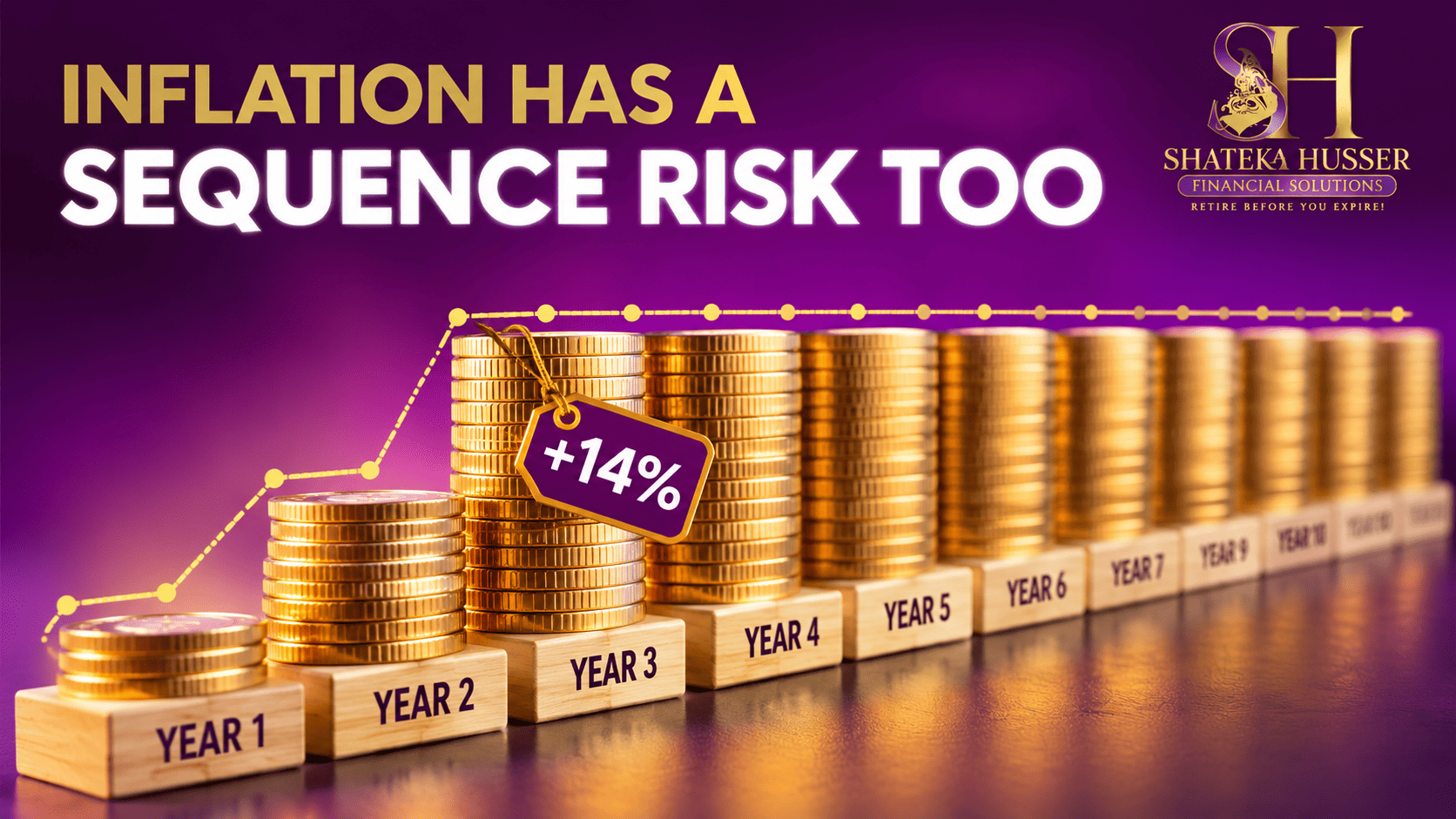
Your retirement plan probably accounts for inflation, but not for when it shows up, and inflation in your first years of retirement does the most lasting damage. You’ve likely heard that market losses hurt most early in retirement. Inflation works the same way.
Key takeaways
- In the research behind the 4% rule, the worst year in U.S. history to retire was 1966, a year followed by more than a decade of rising inflation.
- Inflation early in retirement permanently raises your cost of living. Every later year builds on that higher base.
- Not all retirement income keeps up. Social Security and military retired pay adjust fully; a FERS pension, most private pensions and fixed annuity payments may not.
The worst year to retire wasn’t 1929 or 2008
In 1994, financial planner William Bengen tested every historical starting year to find how much a retiree could safely withdraw. With a 50/50 mix of stocks and bonds, his worst case wasn’t a crash year. It was a retiree who started in 1966, who could have withdrawn at most 4.15%. That number became the “4% rule.”
What made 1966 so hard was prices. Inflation was 2.9% in 1966 and kept rising, reaching 13.5% in 1980. Between 1966 and 1982, prices nearly tripled: a retiree who needed $10,000 a year in 1966 needed about $30,000 by 1982 for the same life.
What “sequence of inflation” means
Inflation doesn’t raise your costs for one year. It resets them, and every year after builds on the new base. So inflation early in retirement compounds for the rest of your life.
Hypothetical example: Two retirees each need $80,000 a year. For their first three years, one sees 6% inflation; the other sees 2.5%. By year four, the first needs about $95,300 a year and the second about $86,200, a gap of $9,100 every year from then on, even if inflation is identical afterward. Over a 25-year retirement, that’s roughly $272,000 more, all from three early years.
And it just happened. Prices rose 7.0% in 2021 and 6.5% in 2022, measured December to December. Anyone who retired at the end of 2020 saw their cost of living rise about 14% in two years. Inflation has cooled, but prices didn’t come back down.
Which retirement income keeps up
| Income source | Inflation adjustment |
|---|---|
| Social Security | Full annual COLA, based on the CPI-W. |
| Military retired pay | Full annual COLA, based on the same CPI-W. REDUX retirees receive 1 point less. |
| CSRS pension | Full COLA. |
| FERS pension | Partial “diet COLA”: 1 point less when inflation is above 3%, capped at 2% when it’s between 2% and 3%. Regular retirees get none until 62, and the FERS supplement never gets one. |
| Most private pensions | Often fixed. Check your plan. |
| Fixed annuity payments | Usually fixed unless you chose an increasing payment. |
| TSP, 401(k), IRA | None automatically. Depends on how it’s invested. |
The FERS gap, in real numbers
Recent COLAs for Social Security and CSRS versus FERS:
| Year | Social Security and CSRS | FERS |
|---|---|---|
| 2022 | 5.9% | 4.9% |
| 2023 | 8.7% | 7.7% |
| 2024 | 3.2% | 2.2% |
| 2025 | 2.5% | 2.0% |
| 2026 | 2.8% | 2.0% |
| 2027 | 3.6% | 2.6% |
Three ways that gap shows up, using a hypothetical $40,000 FERS annuity:
- Over the last six years: for a retiree already 62 in 2021, those COLAs grow the annuity to about $49,300 by 2027. Full COLAs would have made it about $51,900, so it’s about $2,600 a year behind.
- Over 20 years: if inflation averaged 3.5% and FERS paid 2.5%, the annuity would buy about 18% less after 20 years, roughly $32,900 in today’s dollars. At 2.5% inflation, it would buy about 9% less.
- Retiring before 62: a regular FERS retiree who leaves at 57 gets no COLA for five years. At 3% inflation, that annuity has lost about 14% of its buying power before the first increase arrives.
Check your own inflation exposure in five minutes
- List your guaranteed monthly income: Social Security, pensions, retired pay, annuities.
- Label each one: full COLA, partial COLA or no COLA.
- Add up the full-COLA share. That percentage is how much of your income is protected from inflation.
- Compare it with your essential bills. If your fully adjusted income covers less than your essentials, inflation will force larger withdrawals from savings, likely in the same years you can least afford them.
Hypothetical example: A retired federal couple receives $3,000 a month from Social Security (full COLA), $3,500 from a FERS annuity (partial COLA) and $2,000 from TSP withdrawals (no automatic adjustment). Only about 35% of their $8,500 income is fully protected from inflation.
Five ways to position your income against inflation
- Grow the inflation-adjusted floor. Social Security is one of the few incomes with full COLAs for life. If your full retirement age is 67, claiming at 70 instead of 62 makes that check about 77% larger, permanently, and every future COLA applies to the bigger amount.
- Protect the next few years. Treasury Inflation-Protected Securities (TIPS) have principal that adjusts with the Consumer Price Index, which can help cover near-term spending without being exposed to rising prices.
- Keep long-term money growing. Money you won’t need for 10 years or more has to outpace prices. Moving everything to the safest option protects against losses but can quietly lose to inflation.
- If you’re FERS, plan for the gap. Assume your pension will lose buying power over time, and decide now which savings will make up the difference.
- Separate essential from flexible spending. If prices jump early, a plan that can trim travel or extras for a year or two holds up far better than one that can’t.
Frequently asked questions
What is sequence of inflation risk?
The risk that high inflation arrives early in retirement. Because inflation permanently raises your costs, early increases compound for every remaining year and do more damage than the same inflation later.
Does a FERS pension keep up with inflation?
Not fully. FERS pays a reduced COLA when inflation is above 2%, regular FERS retirees receive no COLA until 62, and the FERS supplement receives none.
Does military retired pay keep up with inflation?
Generally yes. Military retired pay adjusts with the same index as Social Security, except under the REDUX plan, which pays 1 point less.
Retirement is a position, not a date
A plan that only works if inflation behaves isn’t positioned. Retirement isn’t an age. It’s an income, and a positioned income has been stress-tested against the years when prices rise fastest, especially the first ones.
Your next step
A complimentary 10-minute Wealth Clarity Call is your opportunity to see how much of your retirement income actually keeps up with inflation, and what your plan would do if prices jumped in your first years.
Schedule your Wealth Clarity Call
Prefer to learn first? Join our complimentary Executive Retirement Briefing to learn how retirement income, protection and legacy work together.
Reserve your seat at the Executive Retirement Briefing
This article is for educational purposes only and is not individual investment, tax or insurance advice. Historical inflation figures are from the Bureau of Labor Statistics Consumer Price Index (annual averages for 1966 to 1982; December-to-December changes for 2021 and 2022). COLA figures are as announced for Social Security, CSRS and FERS. Social Security claiming percentages assume a full retirement age of 67. The examples are hypothetical, simplified and do not represent any specific person. The 4% guideline is based on historical data and is not a guarantee. Past returns and past inflation do not predict the future. No strategy eliminates market or inflation risk. TIPS can lose value if sold before maturity. Annuity features and guarantees depend on the contract and the claims-paying ability of the issuing insurance company. Shateka Husser Financial Solutions offers insurance and annuity products; this article is not a recommendation to buy or sell any product.